
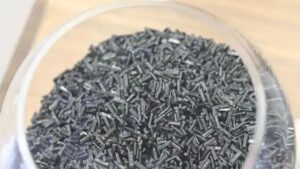
Basalt fiber is a continuous inorganic amorphous fiber produced by melting basic volcanic rock at high temperatures and then drawing it into filaments.
Due to the high content of components such as silicon dioxide, aluminum oxide, and iron oxides in volcanic rock, basalt fiber possesses properties including high strength, high modulus, low thermal conductivity, wear resistance, stability across low and high temperatures, and good chemical stability. It is currently widely used in industries such as concrete, high-temperature filtration, building insulation, vehicle engineering, wind power, petrochemicals, and sports and leisure.
As a natural cosmic material, basalt is not only abundantly distributed on Earth but also exists extensively on the Moon, Mars, and throughout the vast universe. Developing and refining basalt fiber production technology holds profound significance for humanity’s future utilization of in-situ space resources. Furthermore, some other high-performance fibers, such as continuous alumina fiber, boron nitride fiber, and silicon boron nitride fiber, are still in the R&D phase awaiting mass production.
Advancements in precursor heat treatment technology are needed to achieve breakthroughs in industrial production and application, thereby improving the stability of fiber performance.