

Basalt fiber, also known as basalt yarn, has been widely used in many fields,
including military, building materials, fire protection, environmental protection, electrical appliances, and aerospace.
It is considered the fourth largest fiber after carbon fiber, aramid fiber, and ultra-high molecular weight polyethylene fiber, and is a pollution-free “green industrial material”.
1.Composition and structure of basalt fibers
1.1 Composition
Basalt fibers contain almost all elements found in the Earth’s crust, with Si, Mg, Fe, Ca, Al, Na, and K accounting for over 99%.
The main components include Si (26.36%), Ca (18.93%), Al (7.89%), Mg (6.90%), O (31.81%), K (1.18%), Na (1.63%), Ti (1.26%), and Fe (4.04%).
SiO₂ is the most abundant component in basalt continuous fibers, accounting for 45-60%, maintaining the fiber’s chemical stability and mechanical strength;
Al₂O₃ accounts for 12-19%, improving the fiber’s chemical stability, thermal stability, and mechanical strength;
CaO accounts for 6-12%, which is beneficial for improving the fiber’s resistance to water corrosion, hardness, and mechanical strength;
Fe₂O₃ and FeO account for 5-15%, with high iron content, giving the fiber a bronze color.
1.2 Structure
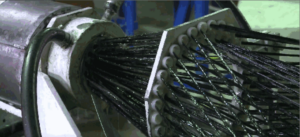
The appearance of basalt fibers resembles an extremely thin tube, a smooth cylinder with a perfectly circular cross-section.
This structure is due to the shrinkage of molten basalt into a circle with minimal surface area during the forming process under surface tension.
2.Properties of basalt fiber
2.1 Tensile Strength
The tensile strength of basalt fiber is 10-15 times that of ordinary steel and 1.4-1.5 times that of E-type glass fiber.
The strength of its continuous fibers far exceeds that of natural and synthetic fibers, making it an ideal reinforcing material.
The tensile strength of continuous basalt fiber is 3000-4840 MPa, higher than some other common high-tech fibers.
2.2 Elastic Modulus
The elastic modulus of basalt fiber is similar to that of expensive S glass fiber, and its strength is comparable.
When used to weave products with a surface density of 150-210 g/m², it exhibits good weaving performance.
It can replace S glass fiber in the manufacture of thermal insulation products and composite materials,
as well as in the production of hard armor and various GFRP products.
2.3 Temperature Resistance
The operating temperature range of basalt fiber is -260-650℃ (softening point 960℃), while that of E-glass fiber is -60 to 350℃.
When operating at 400℃, basalt fiber retains 85% of its initial strength at break; when operating at 600℃, it retains 80% of its original strength after breakage.
2.4 Electrical Properties
The volume resistivity and surface resistivity of continuous basalt fiber are an order of magnitude higher than those of E-glass fiber.
The dielectric loss tangent of basalt fiber is similar to that of E-glass fiber.
Basalt fiber treated with a special sizing agent has a dielectric loss tangent 50% lower than that of ordinary glass fiber,
making it suitable for manufacturing high-voltage (up to 250kV) electrical insulation materials, low-voltage (500V) devices, antenna radomes, and radar and radio equipment.
2.5 Sound Insulation
Continuous basalt fiber exhibits excellent sound insulation and absorption properties.
Basalt continuous fibers exhibit extremely low hygroscopicity, with a moisture absorption rate of only 0.2-0.3%, and this absorption capacity remains constant over time.
Sound insulation materials made from basalt continuous fibers hold great promise for applications in the aerospace and shipbuilding industries.
2.6 Dispersibility
Basalt fibers are made from volcanic extrusive rocks, which are also silicates, and share essentially the same composition as concrete.
Therefore, basalt fibers demonstrate superior compatibility and dispersibility with concrete compared to other reinforcing fibers,while also exhibiting excellent bonding properties.
2.7 Chemical Properties
Chemical stability refers to the fiber’s ability to resist erosion by media such as water, acids, and alkalis,
typically measured by the loss of mass and strength before and after exposure.
Basalt continuous fibers possess more stable chemical properties than glass fibers.
This characteristic opens up broad prospects for the application of basalt continuous fibers in concrete structures such as bridges and dams,
as well as in structures frequently exposed to high humidity, acids, and alkalis, such as asphalt concrete pavements and runways.

3.Basalt fiber production process
3.1 Preparation Methods of Basalt Fiber
Depending on the container used to melt the raw materials,
the methods for producing basalt fiber include the crucible method and the tank furnace method.
The tank furnace method, also known as the direct method, is currently the main method used for basalt fiber production.
Compared with the crucible method, the tank furnace method eliminates the pelletizing process, thus simplifying the process;
in addition, the tank furnace method has advantages such as energy saving,
less pollution, smaller size, smaller footprint, higher yield, and less waste fiber.
3.2 Basalt Fiber Production Process
Select suitable basalt ore raw materials, crush and wash them, and store them in a silo for later use.
The raw materials are then fed into a unit melting furnace via a feeder.
The raw materials melt in a high-temperature primary melting zone of approximately 1500℃.
The melt flows into the drawing furnace. To ensure complete melting of the basalt melt, sufficient homogenization of its chemical composition,
and full volatilization of bubbles within the melt, the melting temperature in the drawing furnace is generally appropriately increased,
while ensuring a longer residence time of the melt in the furnace. Finally, the basalt melt enters two temperature control zones,
adjusting the melt temperature to approximately 1350℃, the drawing and forming temperature.
The initial temperature control zone is used for “coarse” temperature adjustment,
and the forming zone temperature control zone is used for “fine” temperature adjustment.
Qualified basalt melt from the forming zone is drawn into fibers through a 200-hole platinum-rhodium alloy spinneret.
After applying a suitable sizing agent, the drawn basalt fibers pass through a bundler and fiber tensioner, and finally to an automatic winding machine.
4.Applications of basalt fiber
Basalt fiber is mainly suitable for applications in environmental filtration, concrete reinforcement, building repair, road construction, and medicine.