
Star of Future Engineering Materials Quartz Fiber: High Temperature Resistance,Flame Retardancy, Thermal Insulation
Quartz fiber is a special type of glass fiber made from high-purity quartz or natural crystal through high-temperature melting and drawing.
It consists of fine filaments with a single filament diameter between 1-15 μm, appearing white, soft, and lustrous. Its main component is silicon dioxide, typically with a content exceeding 99.90%.
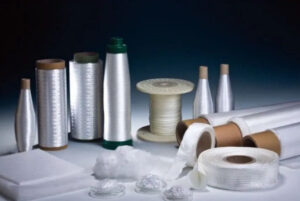
Exceptional Properties
Quartz fiber, with its high silica content, retains some characteristics and properties of solid quartz. It exhibits high heat resistance, excellent high-temperature and high-frequency electrical insulation, ablation resistance, thermal shock resistance, and good chemical stability.
It can be used long-term at temperatures up to 1050℃, with instantaneous resistance reaching 1700°C. Its tensile strength is three times that of ordinary fibers.
Furthermore, it possesses superior dielectric properties, having the lowest dielectric constant and dielectric loss coefficient among all mineral fibers. At 1MHz, the dielectric constant is 3.70, and the dielectric loss coefficient is below 0.001.
In high-frequency applications and at temperatures below 700℃, quartz fiber maintains the lowest and most stable dielectric constant and dielectric loss, while retaining over 70% of its strength.
It is commonly used for structural reinforcement, wave transmission, and thermal insulation in key parts of aviation and aerospace vehicles.
Primary Manufacturing Methods
Quartz glass fiber is primarily produced through three methods: direct melting and drawing, rod drawing, and sol-gel process. Among these, the rod drawing method is the main industrial production technique.
Firstly, raw material crystal or pure silicon dioxide powder is placed in a vacuum pressurized resistance furnace, melted, and drawn into thin rods (approximately 2mm in diameter).
During the drawing process, a sizing agent is first applied to the quartz fiber. It is then placed in an electric heating or hydrogen-oxygen flame environment for drawing, obtaining a primary filament with a diameter of about 8μm.
Finally, the primary filaments are piled and twisted to obtain fiber yarn or fiber fabric.
The specific drawing process can be summarized as follows: molten high-temperature quartz drips from the bottom end of the quartz rod, and the drawing machine maintains a constant rotation rate, thereby stretching and solidifying the fiber to form continuous filaments.
A meniscus-shaped fine filament, known as the “fiber root,” forms at the lower part of the quartz rod. It is important to note that the temperature of the single filament drops significantly after being drawn out, which can affect the product’s performance.
Quartz Fiber Products
Quartz fiber primary filaments can be processed into various quartz fiber products through subsequent different methods.
Based on product form, these can be categorized into quartz fiber yarn, quartz wool, quartz felt, quartz yarn, quartz cloth, quartz sleeving, quartz fiber chopped strands, etc. Quartz fiber yarn is a common product widely used in manufacturing aircraft radomes.
QUARTZ CHOPPED FIBER
Quartz chopped fiber is made from pre-cut quartz glass fibers of fixed lengths.
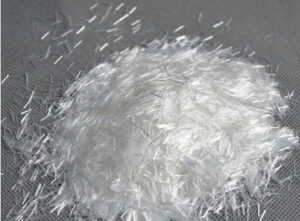
Applications: Mixed with synthetic rubber resins (e.g., rubber, silicon phenolic plastic) as ablative materials; mixed with thermoplastic resins as molds for injection or compression molding; mixed with ceramic prepregs and fired as reinforcement for ceramics.
Quartz Fiber Yarn
Quartz fiber yarn is a continuous long fiber made from high-purity silicon dioxide and natural quartz crystals. Its SiO₂ content can reach over 99.95%.

It can be used long-term in high-temperature environments up to 1050°C and possesses extremely low and stable dielectric constant and dielectric loss. It is a flexible inorganic fiber material with excellent dielectric properties and ultra-high temperature resistance.
Applications: High-temperature resistant and wave-transparent materials for aircraft, substrates for high-frequency printed circuit boards, auxiliary materials for aerospace electronic components, radome wave-transparent materials, etc.
Quartz Fiber Cloth
Quartz fiber cloth is woven from quartz fiber yarn using plain, satin, twill, leno, and other weaves into various thicknesses and weave styles.
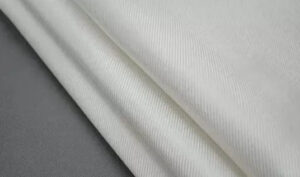
It possesses properties such as high temperature resistance, high strength, low dielectric constant, low thermal conductivity, and ablation resistance.
Applications: Can be used as wave-transparent materials for rockets and aircraft, fire-refractory materials for high-end firefighting suits, protective covers for ultra-high temperature equipment, insulation blanket and cover fabrics, high-temperature resistant, insulating, heat-preserving, and sealing materials, etc.
Quartz Fiber Wool
Quartz fiber wool consists of pure quartz fibers, contains no binder, is amorphous, continuous, lumpy, white, odorless, and has no volatile components.
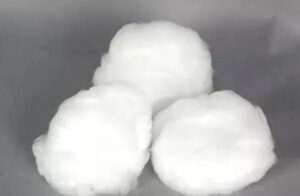
The irregularity in fiber length, shape, and arrangement gives the quartz wool a crimped appearance, preventing compression of the filling material and improving insulation performance. It is a good substitute for high-silica fiber wool, ceramic fiber wool, and basalt fiber wool.
Applications:Thermal insulation materials and high-temperature sealing filler materials in the optical fiber and automotive glass industries; filter materials for high-temperature acidic liquids and gases, and insulation materials for reactors; thermal insulation for various kilns, high-temperature pipelines, and containers.
Factors Affecting Quartz Fiber Strength
(1) Fiber Diameter and Length
Generally, the finer the diameter of the quartz fiber, the higher its tensile strength. The tensile strength of quartz fiber is also related to its length; it decreases significantly in a linear fashion as the fiber length increases.
The influence of diameter and length on quartz fiber can be explained by the micro-crack hypothesis: as the fiber diameter and length decrease, the number of micro-cracks in the fiber correspondingly reduces, thereby increasing the fiber strength.
(2) Influence of Glass Melt Quality on Quartz Fiber Strength**
Effect of Crystalline Impurities:** Fluctuations in glass composition or variations/decreases in bushing temperature may lead to the formation of crystals within the fiber.
Practice has shown that fibers with crystals have lower strength than those without. Additionally, small bubbles in the glass melt can also reduce fiber strength.
(3) Influence of Surface Treatment on Strength
During continuous drawing, a sizing agent must be applied to the single filaments or fiber strands. It forms a protective film on the fiber surface, preventing mutual friction between fibers during textile processing, which could damage the fibers and reduce strength.
After heat treatment removes the sizing agent, the strength of quartz fiber cloth decreases significantly. However, after treatment with an intermediate binder, the strength generally recovers. This is because the intermediate binder coating both protects the fibers and helps compensate for surface defects on the fibers.
(4) Influence of Storage Time on Strength
The strength of quartz fiber decreases after storage for a period; this phenomenon is called fiber aging. It is mainly the result of moisture in the air eroding the fibers. Therefore, fibers with high chemical stability experience less strength reduction.
(5) Influence of Load Duration on Strength
The strength of quartz fiber decreases as the duration of the applied load increases. This is particularly evident when the ambient temperature is high. The reason might be that moisture adsorbed in the micro-cracks accelerates the propagation speed of these cracks under external force.