
Definition of wet-laid nonwoven fabric
Wet-laid nonwoven fabric is a textile material produced by mixing fiber raw materials with water to form a suspension, dehydrating the suspension using a wet-laid process to form a fiber web, and then reinforcing it with chemical or thermal bonding.
In reverse osmosis membrane substrate applications, this material requires a thickness controlled at 85-100 μm, an air permeability of 15-20 mm/s, and a longitudinal tensile strength of not less than 80 N/15 mm.
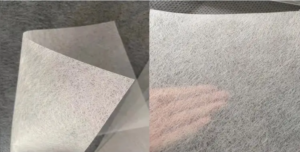
Process Principle
Wet-laid nonwoven fabric refers to a technology in which fiber raw materials placed in an aqueous medium are opened into single fibers, and different fiber raw materials are mixed to form a fiber suspension, which is then transported to a web-forming mechanism for web formation and reinforcement into a fabric in a wet state. The process typically includes basic steps such as fiber preparation, wet web formation, web bonding, and finishing.
Currently, washable nonwoven fabrics are mostly produced using the wet hydroentangling process.
This process uses biodegradable plant fibers such as wood pulp fibers and cellulose fibers as raw materials.
The web formation method is similar to papermaking, where an ultra-low concentration suspension of wood pulp fibers and cellulose fibers is formed, and then a wet web is created using a wet forming machine.
This web is then consolidated by high-pressure water jetting, without the addition of any additives. Finally, drying is performed to obtain the wet hydroentangled nonwoven fabric.
Characteristics of wet-laid nonwoven fabrics
Wet-laid nonwoven fabrics, based on a wet-laid web forming process, have the following basic characteristics: [1-3]
1. High production speed, reaching up to 400m/min.
2. Suitable for web forming of short fibers with a length of 20mm or less.
3. Almost no restrictions on the mixing of fibers of different qualities.
4. Fibers are randomly arranged in the web, and wet-laid nonwoven materials are almost isotropic.
5. Good product bulkiness and web uniformity.
6. Low production cost.
7. Limited possibility of changing the variety of wet-laid nonwoven materials.
8. High water consumption.
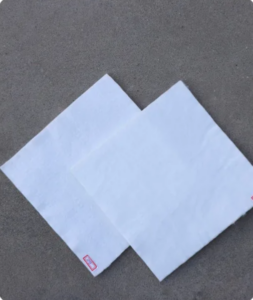
Application areas
Wet-laid nonwoven fabrics are widely used in medical and health care, home decoration and clothing, industrial fabrics, civil engineering, automotive industry, agriculture and horticulture, packaging materials and other fields, as well as in other products such as map cloth, calendar cloth, and canvas.
Related Research
In the preparation and performance study of wet-laid nonwoven paper-based lithium-ion battery separators, modified polypropylene fibers and cotton fibers were mixed and a wet-laid nonwoven fabric forming process was used to prepare a paper-based lithium-ion battery separator with high strength, good hydrophilicity, and good thermal stability.
Related Research
In the preparation and performance study of wet-laid nonwoven paper-based lithium-ion battery separators, modified polypropylene fibers and cotton fibers were mixed, and a wet-laid nonwoven fabric forming process was used to prepare a paper-based lithium-ion battery separator with high strength, good hydrophilicity, and good thermal stability.
In the research of biodegradable nonwoven materials, a pure chitin wet-laid nonwoven fabric with antibacterial properties was prepared by improving the wet process.
After adding 0.2%~1% of bonding fibers, the air permeability, extensibility, and flexibility of the nonwoven fabric were improved, and it met the standards for medical dressings.