Table of Contents
ToggleThe premature failure of building waterproofing systems is typically not caused by the chemical degradation of the waterproofing coating itself; rather, it results from structural stress concentrations—induced by building settlement or thermal expansion and contraction—that cause the waterproofing layer to rupture under tension or the substrate to crack.
In the application of modern high-performance waterproofing membranes and liquid coatings, the incorporation of a high-strength reinforcement matrix is a key measure for extending the service life of the project.
The Evolution of Fiberglass Waterproofing Technology
Fiberglass waterproofing refers to the integration of inorganic glass fiber matrices into bituminous coatings or liquid membranes to deliver high dimensional stability, tensile resistance, and rot-proof performance under severe environmental loads.
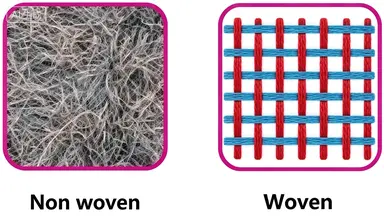
Due to its inorganic nature, fiberglass is inherently resistant to mold and rot and possesses an extremely low coefficient of thermal expansion; its application in waterproofing has evolved from traditional woven mesh fabrics to modern non-woven thin mats.
Traditional woven fabrics with a standard warp-and-weft structure are highly susceptible to shear tearing when subjected to diagonal loads, such as those acting at a 45-degree angle. In contrast, the requirements for base reinforcements in modern architectural waterproofing have shifted decisively toward non-woven fiberglass materials capable of dispersing stress in all directions.
In accordance with the ASTM D1668 Type I standard, fiberglass fabrics used for roofing and waterproofing must possess sufficient warp and weft tensile strength (typically required to be no less than 75 lbf/in) to ensure that no physical deformation occurs during the asphalt impregnation or polyurethane coating process.
Why is wet-laid fiberglass mat the gold standard for waterproofing membranes?
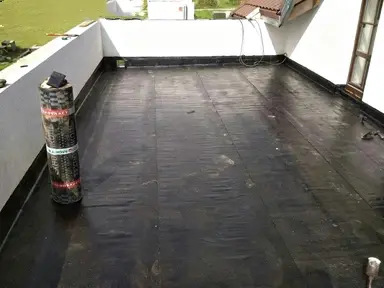
Wet-laid fiberglass mat is a non-woven industrial tissue manufactured by dispersing chopped glass fibers uniformly in a water-based chemical solution, followed by matrix formation on a moving wire and curing with specialized resinous binders.
As an original manufacturer, we employ precise control over process parameters to endow the wet process with three micro-physical advantages unattainable by the traditional dry process—factors that are critical in determining the quality of waterproofing projects:
- Isotropic Reinforcement: 50mm chopped glass fibers are fully dispersed in water and randomly interwoven. This ensures uniform tensile strength across longitudinal, transverse, and diagonal directions, effectively handling localized stresses caused by irregular building settlement.
- 100% Optimal Impregnation & Wet-Out: The wet-laid thin mat features exceptional and uniform porosity. During the application of hot-melt modified bitumen (SBS/APP) at 180°C or liquid polyurethane, the coating rapidly penetrates the mat at a rate of 70–100 g/m² while effectively displacing air; this completely eliminates the risk of future leakage caused by blistering or pinholes.
- Exceptional Thermal Shock Resistance: Fiberglass mats cured with modified urea-formaldehyde or acrylate binders exhibit a near-zero rate of dimensional change when subjected to the thermal shock of alternating extreme UV exposure and sudden, heavy downpours, thereby permanently preventing creep and brittle cracking in the waterproofing layer.
Comparison Table of Technical and Physical Performance Parameters
The following is a matrix of typical physical parameters for wet-laid glass fiber mats that meet industrial-grade waterproof standards:
| Property | Test Method | Typical Range | Engineering Benefit |
|---|---|---|---|
| Tensile Strength | ASTM D638 / ASTM D146 | 75 – 150 MPa | Resists substrate cracking and prevents the waterproofing layer from tearing. |
| Moisture Content | ISO 3344 | ≤ 0.20% | Prevent the formation of expansion bubbles during high-temperature asphalt coating. |
| Area Weight | ISO 3374 | 25 – 50 g/m² (thin mat) / 225 – 450 g/m² (thick mat) | Meets diverse needs ranging from reinforcement for liquid coatings to base mats for rolled membranes. |
| Chemical Resistance | Acid-Base Immersion Test (pH 2–12) | Mass loss < 1.5% | Ensure resistance to soil acid-alkali corrosion in underground waterproofing projects. |
Key Applications of Fiberglass Mats in Modern Waterproofing
Due to the uniformity of their microstructure, wet-laid glass fiber mats are widely used in the following three core waterproofing sectors:
- Carrier for SBS/APP Modified Bitumen Waterproofing Membranes: Serving as the core reinforcement for the membrane, it withstands high tensile forces during production and imparts excellent weather resistance to the finished product.
- Reinforcement for Liquid-applied Waterproofing Systems: A reinforcing mat used as an intermediate layer during the application of polyurethane, acrylic, or cold-applied asphalt liquid coatings to provide a crack-resistant barrier.
- Pipe Wrapping & Underlayment: In accordance with the ASTM D6506 standard, heavy-duty fiberglass mat serves as a robust protective layer for underground waterproofing systems, preventing stones in the backfill from puncturing the waterproofing structure.
Technical and Procurement FAQ
Why must the moisture content of fiberglass mat in waterproofing projects be controlled below 0.20%?
If the moisture content of the base mat exceeds the limit, trace amounts of moisture will instantly vaporize and expand upon contact with hot modified bitumen at approximately 180°C. This creates numerous microscopic voids and blisters within the membrane—defects often invisible to the naked eye—which become the initial points of delamination and leakage during subsequent cycles of high and low temperatures.
What weight (in grams) of fiber mat should be selected for reinforcing liquid waterproofing coatings?
For most on-site liquid spray or brush applications (such as liquid roofing waterproofing), a 45 g/m² to 50 g/m² wet-laid fiberglass mat offers the optimal balance; it ensures rapid coating penetration and wetting while providing sufficient physical tensile strength to prevent the coating from sagging or running.
Establish a long-term, stable supply chain for fiberglass waterproofing materials.
Selecting a supplier with in-house manufacturing capabilities—and the ability to consistently provide products meeting ASTM standard testing parameters—is the first step toward ensuring compliance in large-scale construction projects. We provide customized wet-laid fiberglass mat solutions to global manufacturers of waterproofing membranes and engineering contractors.
If you are selecting materials for your next waterproofing project, or need to evaluate the physical parameters of a base mat with a specific basis weight:
[Contact our application engineers: Request a free laboratory test sample]
Technical References & Industry Standards
Johns Manville. Nonwoven Technology for Bituminous Roofing Applications. (Technical documentation on custom fiberglass matrix fabrication for modified bitumen waterproofing membranes).
ASTM International / W.R. Meadows. Technical Data & Manufacturing Standards. (Product formulations manufactured in accordance with ASTM D6506, covering Standard-duty PC-2 and Heavy-duty PC-3 thickness and puncture resistance metrics).
Siplast Roofing Systems. Technical Evaluation & Engineering Guide. (Paradiene 20/30 Engineering & Acrylic/Bitumen compatibility matrix verified under severe solar load and random ponding water conditions).
Malarkey Roofing Products / ISO Certification. Chemical Safety & Material Documentation. (Technical specifications for wet-laid processes utilizing modified urea formaldehyde resinous binders, fully compliant with ISO 3374 Weight and ISO 3344 Moisture standard rules).
Dewitt Products. Technical Product Specifications & Compliance Sheet. (Certified compliance matrix with ASTM D1668 Type I Glass Fabrics standard, anchoring Warp and fill tensile strength values at $\ge$ 75 lbf/in).