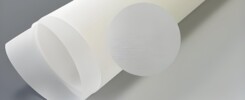
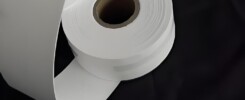
Wet-laid fiberglass nonwoven fabric is manufactured using electronic grade chopped fiberglass strands as raw material, processed through a specialized wet-laid technique.The products exhibit excellent wear resistance, acid and alkali resistance, heat resistance and flame retardancy, thermal insulation, and electrical insulation properties.
Fiberglass Paper
Product Composition:
1. Alkali-free chopped fiberglass strands (E-Glass)
2. Adhesive
Product Applications: Desiccant rotors, structural support material for VOCs rotors
Technical Specifications

Catalyst Substrate

To address specialized user requirements, our company has developed and is capable of continuously mass producing a series of high temperature resistant products. This range includes wet-laid fiberglass nonwoven fabrics capable of withstanding temperatures of 250°C, 435°C, and 550°C, thereby meeting the specific demands of users in specialized applications.
High-Temperature Lithium Thionyl Chloride Battery Separator Paper
Product Composition: 1. Alkali-free Chopped Glass Fibers (E-Glass)
2. Binder
Technical Specifications

Fiberglass Membrane
Product Composition: 1. Alkali-free chopped fiberglass strands (E-Glass)
2. Adhesive
Applications: Fiberglass membranes are utilized within the structure of test strips as sample pads, conjugate pads, and bridge pads.
Technical Specifications

Characteristics of Fiberglass Membranes
— High surface uniformity and flatness; uniform fiber dispersion
— High flow rate and excellent release properties
— Good hydrophilicity
— Good processability
Composition: 100% Polyester Fiber (PET)
Wet-laid Polyester Nonwoven Fabric: This material is produced by dispersing raw fibers within an aqueous medium into individual filaments, simultaneously blending them to form a fiber slurry. This slurry is then conveyed to a web-forming mechanism, where the fibers are formed into a web while still in a wet state, and subsequently bonded to create the finished fabric.
Product Characteristics
· Excellent uniformity and consistency in basis weight and thickness
· Good chemical and thermal stability
· Good dimensional stability
· Wide range of basis weights and bulk densities; surface characteristics, porosity, and pore size can be customized to meet specific user requirements

Reverse Osmosis Membrane Support Material Technical Data

- Can be customized according to the client’s specific needs.
MBR Flat Sheet Membrane Substrate Technical Data

- Can be customized according to the client’s specific needs.

Pore Size Analysis Data

Solution:
Average Pore Diameter: 4.5532 um
The MostDiameter: 1.1660 um
BubblePoint Diameter: 19.8403 um
Minimum Diameter: 0.6165 um
Average Pore Pressure: 0.0999 bar
Bubble Point Pressure: 0.0229 bar
Bubble Point Flow: 0.0069 L/min
Minimum Pore Pressure: 0.7376 bar
Gas Permeability: 5.41E-05 m3/(m 2.pa.s)
P=0.1000bar)(Gas Flux): m~3/(m~2*h)