Table of Contents
ToggleThe core logic for distinguishing between the two is simple: look past the unit price on the invoice and focus instead on the actual structural load-bearing characteristics of your project.
Fiberglass cloth is a classic example of an anisotropic material, with physical strength highly concentrated along the two perpendicular axes of the warp and weft.
In contrast, fiberglass mat—particularly non-woven mat produced via the wet-laid process—is an isotropic material, offering dimensional stability and physical protection in all directions across three-dimensional space.
1. Let each material perform its specific function.
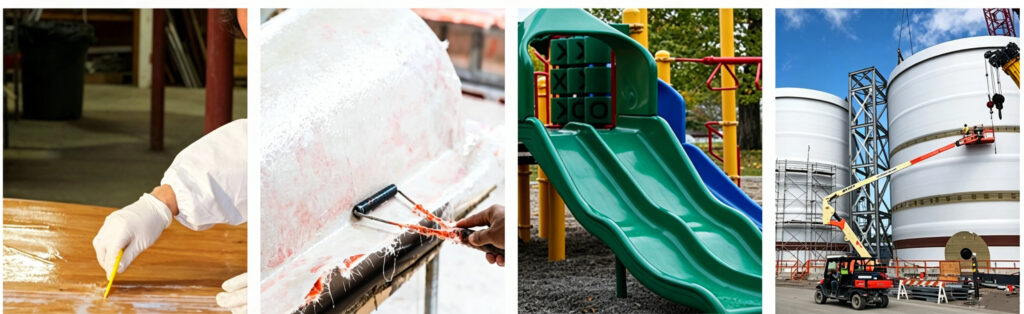
If the material selection is mismatched, not only will the material fail to perform to its full potential, but subsequent quality complaints and claims from customers can also become a major headache.
How to choose fiberglass cloth?
Because its continuous fiber strands are mechanically interwoven, it offers exceptional tensile strength along the 0°/90° axes.
This makes it an ideal choice for high-load structural components such as surfboards, racing boat keels, and drone shells—applications where the material must withstand intense, unidirectional mechanical tension.
How to choose fiberglass mat?
Fiberglass mat is the superior choice when your project requires dimensional stability in all directions, needs to conform to complex curved molds, or demands strict inorganic protection.
Prime examples include anti-corrosion linings for heavy-industrial storage tanks, the molding of complex 3D shapes, and high-performance fiberglass-mat-faced gypsum board used in modern construction.
In accordance with the [ASTM C1658/C1658M] standard, replacing traditional paper facings with inorganic non-woven fiberglass mats eliminates organic nutrient sources; consequently, when tested under [ASTM D3273] protocols in high-humidity environments, the material consistently achieves a top-tier mold resistance rating of 10.
Fiberglass Mat vs. Fiberglass Cloth:
| Performance dimension | Fiberglass cloth | Fiberglass mat | Impact on production |
|---|---|---|---|
| Fiber micromorphology | Continuous fibers, tightly woven in both warp and weft directions. | Chopped glass fibers, randomly distributed. | Determine whether the applied force is directional. |
| Resin consumption | Low (compact structure, low absorption capacity) | High (high porosity, high absorption capacity) | Directly affects the total weight after curing. |
| Surface conformability | Poor (constrained by rigid longitudinal and transverse tension, prone to springing open) | Excellent (no directional restrictions, easy to apply) | Determines the operational difficulty of complex, irregularly shaped molds. |
| Clipping marginal effects | The edges are highly prone to fraying and unraveling. | Can be cut in any way without fraying (Non-fraying) | Directly affects the scrap rate of workshop cutting operations. |
2.Regarding resins, labor, and waste
In terms of price alone, woven fabrics are typically more expensive than non-woven mats due to the additional weaving process involved.
Furthermore, regarding consumables, fiberglass mats—being non-woven materials with a lofty, porous structure—have a high absorption capacity; this inevitably increases the procurement budget for resin, which is a costly consumable.
However, the true cost divide emerges on the actual production line.
When cutting fiberglass cloth, the edges are highly prone to fraying, which not only wastes material but also significantly extends labor time; workers must repeatedly use clamps or tape to adjust and secure the fabric—which tends to spring back due to warp-and-weft tension—when laying it over complex 3D curved surfaces.
In contrast, non-woven fiberglass mats eliminate directional constraints and offer excellent drapeability, allowing them to be cut without any edge fraying.
Technical data from EDANA indicates that the uniform structure of wet-laid nonwovens generates powerful capillary forces, enabling spontaneous and instantaneous resin wet-out.
This rapid wetting not only significantly shortens cycle times for vacuum bagging or manual lay-up operations but also effectively prevents dry spots and micro-voids caused by resin failing to fully penetrate fiber bundles.
By reducing defect rates and labor requirements, switching to nonwoven mats typically allows composite workshops to cut scrap waste and productivity losses by more than 20%.
3.Preventing Fatal Manufacturing Defects
For frontline process engineers, an error in material selection often spells a technical disaster resulting in the scrapping of entire batches:
3.1 Surface Fiber Pattern Visibility (Print-Through)
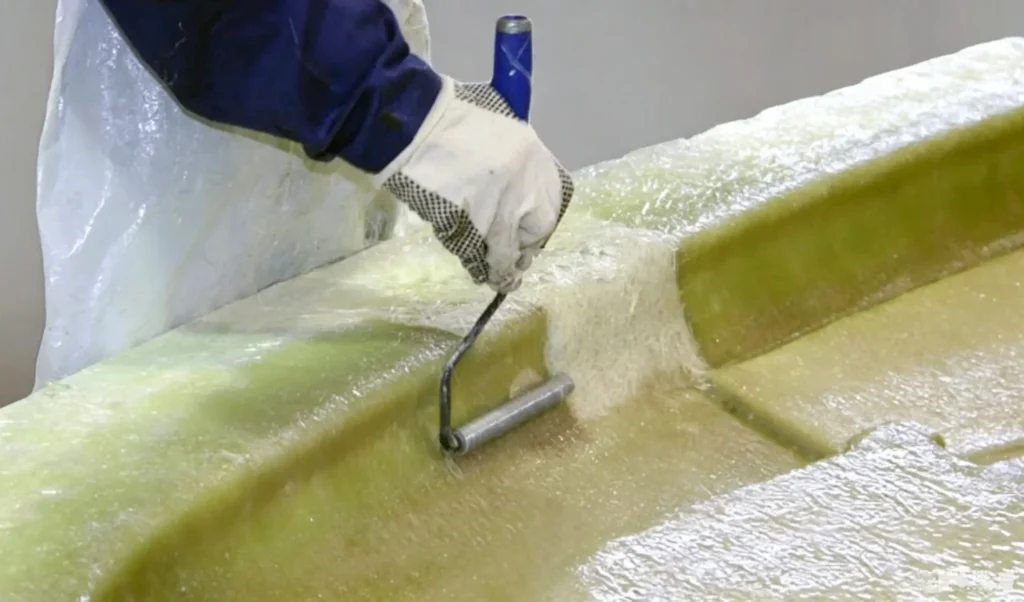
If only woven fabric is used for the outer layer, the microscopic shrinkage of the resin during curing causes a dense, grid-like mesh pattern to appear on the finished surface.
For applications such as automotive body panels, yacht exteriors, or high-end continuous construction panels, this constitutes a critical aesthetic defect.
The ASM Handbook (Volume 21: Composites) clearly explains that uneven microscopic stress at the weave intersections makes localized shrinkage during curing inevitable. Academic research published in Composites Science and Technology confirms the industry-standard solution: introducing a lightweight, inorganic non-woven glass fiber surface veil as the outermost layer.
Acting like a “beauty mask,” it retains the resin to create a uniform, resin-rich layer that completely masks and isolates the underlying fabric mesh pattern, thereby significantly improving surface smoothness.
3.2 Wrinkling and Spring-back (Complex Curvatures)
When dealing with molds featuring sharp radii or complex, fluid geometries, woven fabrics are constrained by anisotropic deformation limitations, making it difficult to achieve a seamless fit; this often results in air pockets or voids of varying sizes forming within the laminate prior to curing.
In contrast, non-woven chopped strand mats are free from directional constraints; workers can easily tear and naturally piece the material together along the mold edges, effectively eliminating the risk of trapped air pockets within complex cavities.
3.3 Interlaminar Delamination in Finished Parts
To achieve maximum tensile rigidity, some technicians stack only woven fabrics when fabricating continuous-fiber laminates.
However, the interface between layers of woven fabric is excessively smooth, lacking the mechanical interlocking provided by microscopic fibers oriented in the transverse (z-axis) direction.
During subsequent machining, or when subjected to lateral impacts or prolonged vibration, the product is highly susceptible to interlaminar cracking—splitting apart much like the layers of a puff pastry.
Under the [ASTM D5528] standard test method for Mode I interlaminar fracture toughness, interfaces consisting solely of woven fabric demonstrate poor resistance to crack propagation.
Research on composite materials has shown that inserting a lightweight layer of non-woven chopped strand mat between two layers of woven fabric—where the randomly oriented short fibers penetrate the resin layer vertically—creates a robust microscopic mechanical interlocking structure. This significantly enhances interlaminar shear strength (ILSS) and completely eliminates the risk of hidden interlaminar delamination in the finished product.
Global Standards and Compliance Frameworks
When assessing the physical reliability of high-performance reinforcement materials and conducting compliance reviews for market entry, adherence to the following standardized technical frameworks is typically mandatory:
ASTM C1658/C1658M (Standard Specification for Glass Mat Gypsum Panels)
ASTM D579/D579M (Standard Specification for Greige Woven Glass Fabrics)
ASTM E84 (Standard Test Method for Surface Burning Characteristics of Building Materials; used to evaluate flame spread and smoke density)
You can verify compliance details by accessing the relevant official standards databases via the links provided above or by consulting the references listed at the end of this document.
Elevate Your Production Quality
We are dedicated to providing global customers with continuous mat solutions featuring customized cutting widths that fully comply with ASTM standards.
Whether you are an R&D engineer struggling with interlaminar delamination or a purchasing manager looking to reduce shop-floor waste and labor costs, please feel free to contact our application engineering team via our [Contact Us] page.
We can provide complimentary sample rolls, Technical Data Sheets (TDS), or structural facing assessments tailored to your specific mold geometries.
References:
ASTM C1658/C1658M-19e01,Standard Specification for Glass Mat Gypsum Panels, ASTM International, West Conshohocken, PA, 2024.
ASTM D3273-21,Standard Test Method for Resistance to Growth of Mold on the Surface of Interior Coatings in an Environmental Chamber, ASTM International, 2023.
ASTM D5528-21,Standard Test Method for Mode I Interlaminar Fracture Toughness of Unidirectional Fiber-Reinforced Polymer Matrix Composites, ASTM International.
ASTM E84-23b, Standard Test Method for Surface Burning Characteristics of Building Materials, ASTM International.
ASM International Handbook Committee, ASM Handbook, Volume 21: Composites, Materials Park, OH.
Microstructural Evaluation of Interlaminar Shear Strength in Hybrid Woven Cloth and Wet-Laid Nonwoven Glass Mat Composites, Composites Science and Technology, Vol. 210, 2025.