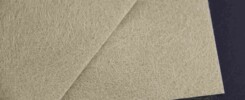
Reverse osmosis (RO) substrate nonwoven fabric is a specialized nonwoven material designed specifically for manufacturing the core components of RO membranes—specifically, the porous support layer of composite membranes.
Characterized by uniform fiber distribution and controllable pore sizes, it offers excellent structural support and filtration capabilities, thereby effectively extending the service life and enhancing the stability of membrane modules.
Acting as the “skeleton” of the RO membrane, it plays a pivotal role in reinforcing mechanical strength, providing stable structural support, and ensuring the uniform distribution of fluid flow.

Product Features of RO Substrate Nonwoven Fabric
Utilizing a proprietary wet-laid production process for chemical fibers developed in-house, the material features a smooth surface finish and exceptional uniformity.
It exhibits a uniform pore size distribution, as well as consistent air permeability and thickness across the entire sheet.
Historically, cellulose acetate was the primary material used; however, aromatic polyamide composite membranes are currently the most widely adopted technology.
Furthermore, novel nanocomposite materials are actively being developed to enhance anti-fouling properties.
Typically, RO membranes employ either asymmetric or composite membrane structures, available in various configurations such as spiral-wound (roll) or hollow fiber formats to accommodate the diverse requirements of different equipment systems.

Main Types and Characteristics
Based on material composition, RO membrane substrate nonwoven fabrics are primarily categorized into the following types:
Polyester Nonwoven Fabric: This is currently the most widely utilized substrate material for RO membranes.
Its key advantages include high tensile strength, exceptional chemical resistance, and excellent dimensional stability.
These attributes ensure the long-term, stable operation of RO membranes under high-pressure conditions and in environments involving complex water chemistries.
Consequently, it is extensively applied in industrial water treatment, seawater desalination, and high-end commercial water purification systems.
Polypropylene (PP) / Polyethylene (PE) Nonwoven Fabric: Characterized by lower production costs and lighter weight, these materials offer distinct advantages in cost-sensitive application scenarios.
They are commonly found in certain residential water purifiers and small-scale commercial water purification equipment.
Other Specialized Nonwoven Fabrics: The market also offers other specialized RO support fabrics that emphasize characteristics such as biodegradability, eco-friendliness, and recyclability.
These materials are suitable for a broader range of environmentally conscious product applications.

Core Functions of RO Substrate Nonwovens
Within the structure of a composite RO membrane, the substrate nonwovenfunctions in tandem with the overlying desalination layer.
Mechanical Support:It withstands the high pressures generated during the operation of the RO system, thereby preventing structural damage or rupture of the desalination layer.
Providing Permeation Channels: Its porous structure creates pathways for water having passed through the desalination layer to flow toward the collection tubes.
Ensuring Uniformity: Uniform fiber distribution and surface flatness serve as the foundation for ensuring the even coating of the ultra thin desalination layer and preventing defects.
Consequently, the technical requirements for the non-woven substrate material are extremely rigorous;
it must possess excellent uniformity in pore size distribution, high porosity, good hydrophilicity, chemical stability, and an exceptionally low level of surface defects.

Industry Development
The non-woven substrate industry for reverse osmosis membranes is characterized by high technical barriers.
Through continuous R&D, the company has successfully achieved large-scale production of its products,
which have now been certified and adopted by numerous leading enterprises in the domestic and international membrane industry.
By investing in production lines equipped with advanced systems such as quantitative online monitoring and defect detection the company has significantly enhanced both production capacity and product stability.
In recognition of these achievements, it has been designated as a “Demonstration Base for the Non-woven Fabric Industry for Separation Membranes.”
Application Fields
Core Water Treatment Sectors:Residential and commercial water purifiers, large-scale industrial wastewater treatment, seawater desalination equipment, municipal sewage treatment, etc.
Other Specialized Fields:It also plays an indispensable role in sectors with extremely stringent water quality requirements, such as swimming pool water treatment,
water preparation for medical and pharmaceutical applications, and water purification for food and beverage processing.