Table of Contents
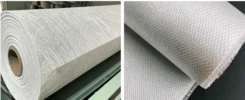
ToggleThe failure of anti-corrosion coatings on Glass Reinforced Plastic (GRP) piping is a costly and persistent industry problem. Many of these pipes successfully pass factory pressure tests.
However, after several years of operation, micro-crack leakage or degradation of the structural layer can still occur in the pipe walls.
Failure analysis indicates that the source of the defect lies neither in the external structural rovings nor in the matrix resin. The true culprit is the skeletal carrier within the innermost corrosion-resistant, resin-rich liner—specifically, the GRP/FRP pipe surfacing veil.
As the primary physical barrier against medium penetration, a high-quality wet-laid fiberglass tissue determines the overall service life of the asset.
1.Longitudinal Tensile Force Balance in the CFW process
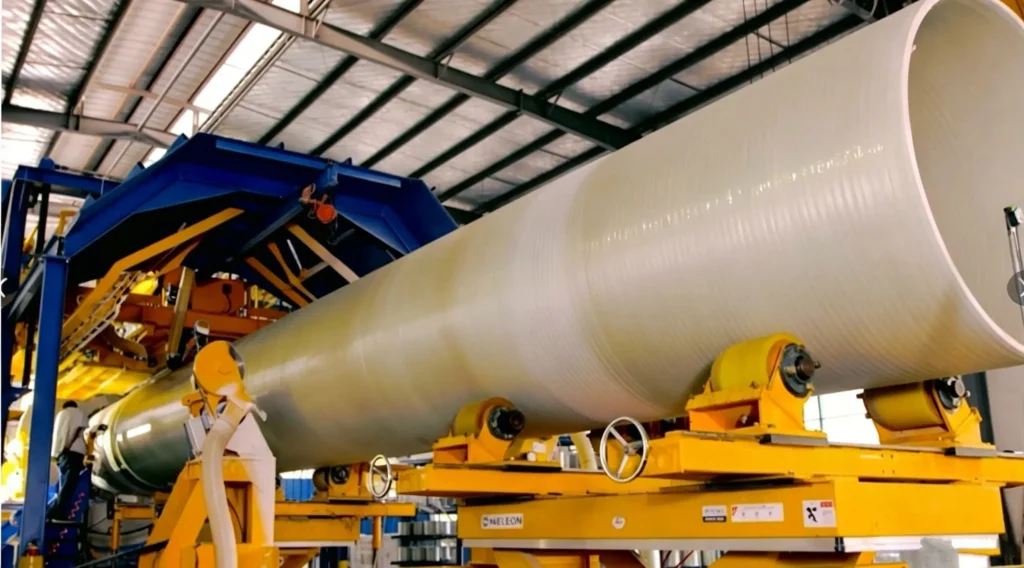
On modern continuous filament winding (CFW) production lines, speed equates to efficiency.
The high-speed rotation of the mandrel and the advancement of the continuous steel strip exert immense longitudinal tension on the incoming sheet material.
Conventional wet-laid fiberglass tissue exhibits relatively low tensile strength. Under high-speed tension, the material is highly susceptible to localized tearing or edge wrinkling. This not only leads to downtime and material waste but, more critically, causes uneven thickness in the cured lining layer due to wrinkling, thereby creating defects associated with stress concentration.
Consequently, modern industrial standards increasingly favor the use of specialized GRP/FRP pipe surfacing veils reinforced with longitudinal (warp-direction) yarns.
Testing in accordance with international standard ISO 3342:2011 demonstrates that this process—incorporating high-modulus longitudinal yarns during the wet-forming stage—significantly enhances the tensile strength of the veil. It ensures the sheet remains flat and taut, enabling continuous filament winding (CFW) production lines to operate efficiently while eliminating structural defects in the liner at the source.
2.The causal relationship between resin impregnation speed and bubble formation.
In fluid dynamics, high air permeability is a critical factor determining the success or failure of corrosion protection. When the resin is poured, the fluid must completely penetrate and encapsulate every glass fiber within an extremely narrow processing window.
The following outlines the direct causal relationship between the microscopic characteristics of wet-laid fiberglass tissue/mat and pipeline defects:
| Key Indicators | Ideal Parameter Range | Based on GRP/FRP Pipe Surfacing Veil Application |
|---|---|---|
| Resin Infiltration Time | ≤10s | If penetration time > 10s — formation of micro-bubbles (voids) and white stains. |
| Basis Weight Uniformity | Complies with ISO 3374:2000 | Excessive basis weight deviation – uneven thickness – osmotic blistering caused by high pressure. |
| Breathability | High gas permeability/diffusion coefficient | If breathability is poor, stress cannot be released, leading to micro-cracking in the lining. |
- If the resin impregnation rate of the wet-laid fiberglass tissue is too slow (penetration time > 10 seconds), the fluid cannot completely displace the air between the fibers.
- When the pipeline is put into high-pressure operation, residual air bubbles evolve into vulnerable stress concentration points. Under the impact of the medium, these defects develop into osmotic blistering, ultimately leading to structural layer delamination and fiber bleeding.
Based on the standards of the Ahlstrom Fiberglass Nonwoven Technologies portfolio, a high-quality GRP/FRP pipe surfacing veil must possess extremely high microporosity. Rapid and complete resin impregnation is essential to form a continuous, dense, resin-rich protective layer on the pipe surface, thereby preventing fiber pattern print-through.
Achieving a bubble-free liner relies heavily on the precise control of the wet-laid production line. At our technical center, we have conducted an in-depth analysis of these fiberglass mat manufacturing processes, detailing how binder distribution influences the final resin absorption rate.
3.Barrier effect across the pH range of 1–14
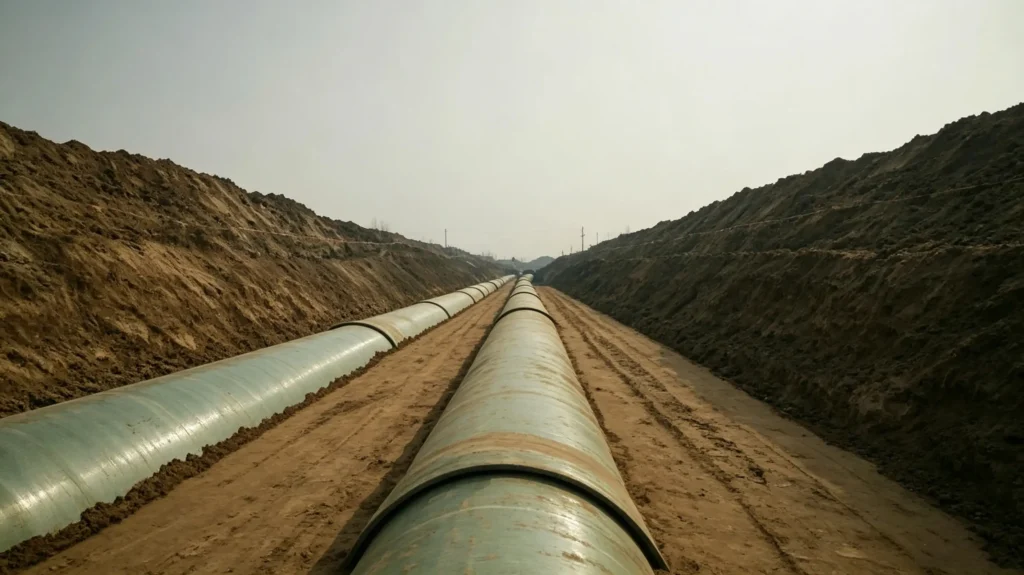
In operating environments such as chemical plant wastewater treatment, the chlor-alkali industry, and seawater desalination, pipe linings must withstand the erosive action of highly corrosive fluids over the long term.
In accordance with the Owens Corning Corrosion Resistant Composites Guide, modern industry increasingly favors corrosion-resistant substrates—such as boron-free E-CR glass fiber—that offer superior hydrolysis resistance.
When a high-quality GRP/FRP pipe surfacing veil is perfectly cured with vinyl ester resin, it achieves an acid and alkali resistance rate of up to 98%. It effectively prevents high-concentration acidic media from penetrating into the structural reinforcement layer, thereby safeguarding the structural integrity of the entire pipeline.
Furthermore, anti-static wet-laid fiberglass tissue is an essential component for explosion-hazardous areas—such as those used for oil and gas transport—where static electricity tends to accumulate. By utilizing conductive modification to lower surface resistance, it instantly dissipates static charges generated by fluid friction, thereby eliminating the catastrophic risk of spark-induced incidents.
4.Procurement and Compliance
In international tenders for municipal and industrial pipeline networks, two recognized industry cornerstone standards are:
- ANSI/AWWA C950-20 — An American Water Works Association standard for pressure pipe that mandates specifications for internal corrosion and permeation resistance in water transmission pipes.
- ANSI/ASTM D3262-16 — Specifies technical requirements for internal corrosion-resistant linings to withstand erosion by sewage and acidic industrial wastewater in buried applications.
To ensure that the wet-laid fiberglass tissue used for the anti-corrosion layer meets engineering specifications, factory quality control must be based on three key tests:
- Verifying mass-per-unit-area uniformity in accordance with ISO 3374:2000.
- Testing breaking strength in accordance with ISO 3342:2011.
- Strictly controlling binder content in accordance with ISO 1887:2014.
5.Long-term asset return
The cost of surface anti-corrosion materials represents a negligible fraction of the total cost of GRP/FRP piping. Yet, it is precisely this thin layer of surfacing material that determines the safe service life of the entire pipeline network.
Investing in high-specification GRP/FRP surfacing veils can reduce in-plant scrap rates and avert the risk of cross-border claims and rework costs—losses that can easily run into the hundreds of thousands of dollars.
You can also contact our application experts directly today to request free samples for trial runs and conduct shop-floor testing.
References
International Organization for Standardization. (2011). Textile glass — Mats — Determination of tensile breaking force (ISO Standard No. 3342:2011).
International Organization for Standardization. (2000). Reinforcement products — Mats and fabrics — Determination of mass per unit area (ISO Standard No. 3374:2000).
International Organization for Standardization. (2014). Glass fibre products — Determination of combustible-matter content (ISO Standard No. 1887:2014).
American Water Works Association. (2020). Fiberglass Pressure Pipe (ANSI/AWWA Standard No. C950-20).
ASTM International. (2016). Standard Specification for “Fiberglass” (Glass-Fiber-Reinforced Thermosetting-Resin) Sewer Pipe (ASTM Standard No. D3262-16).
Ahlstrom Product Solutions. (2026). Fiberglass Nonwoven Technologies for Industrial Composites.
Owens Corning Composites. (2026). Corrosion-Resistant Fiberglass Solutions for Infrastructure and Piping.