When engineers compare nickel coated carbon fiber options, they may see terms such as CVD nickel coated carbon fiber, nickel plated carbon fiber and electroplated nickel carbon fiber.
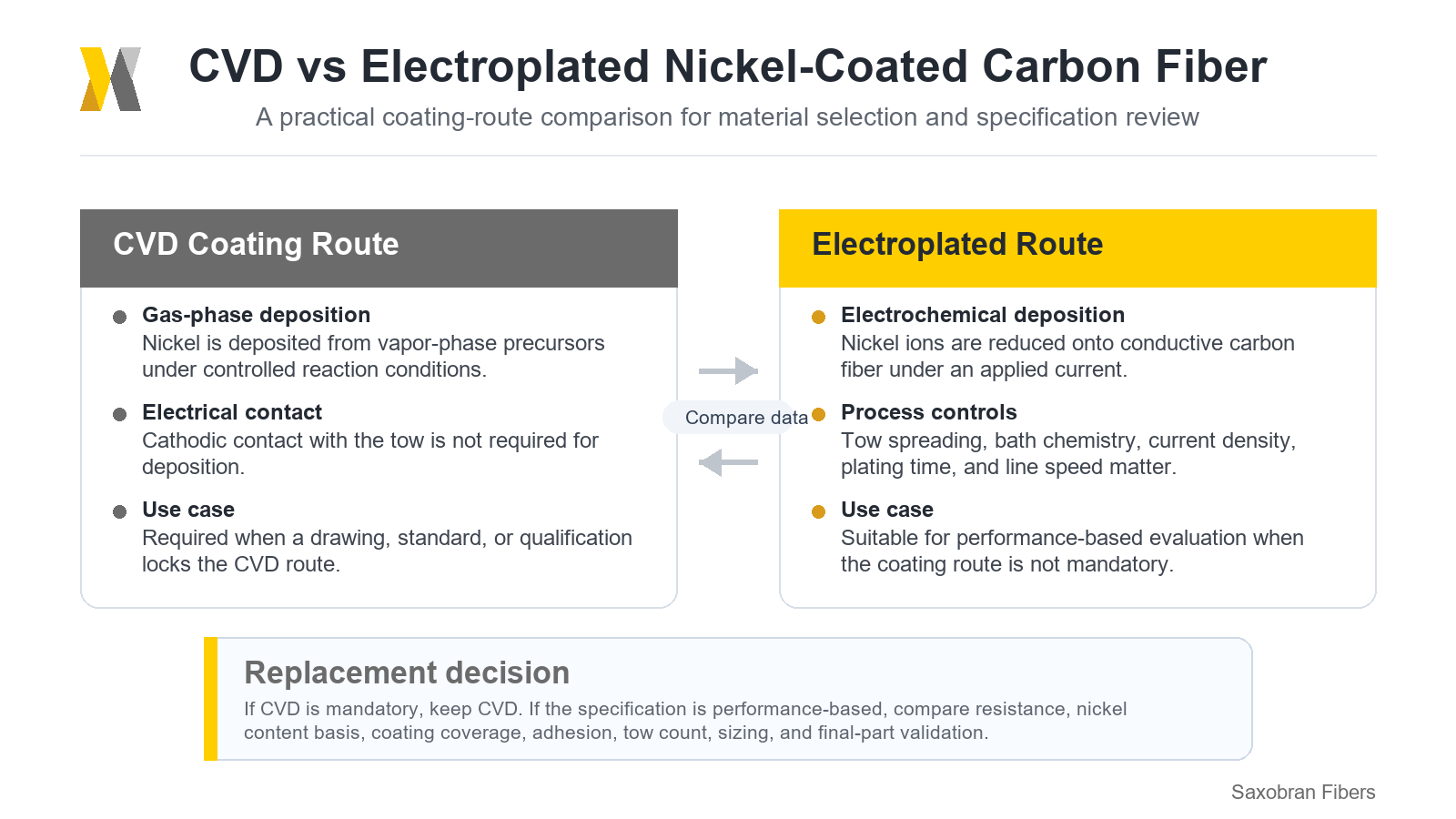
The short answer is that CVD-coated and electroplated nickel-coated carbon fibers are made by different processes and are not automatically interchangeable. If a drawing, qualification document or customer standard requires CVD, the deposition route should not be changed without written approval. If the specification is performance-based, an electroplated alternative may be evaluated using grade-specific electrical, coating, mechanical and processing data.
Saxobran supplies electroplated nickel-coated carbon fiber. If your project originally specifies a CVD-coated material, we can help determine which requirements must be compared before an electroplated tow is submitted for evaluation.
Why This Difference Matters
For many buyers, the first question is simple: “Can this material conduct electricity and fit my process?”
For some engineering teams, however, the coating process itself is part of the specification. If a drawing, qualification document or customer standard says “CVD only,” then the production method must be confirmed before sampling.
If the document specifies only performance targets, there may be room to evaluate another deposition route. However, resistance and nickel content alone are not sufficient to establish equivalence. Coating coverage, adhesion, finished-tow mechanical properties, sizing, environmental durability and application-level validation may also matter.
Terminology note: Nickel-coated carbon fiber can also be produced by electroless plating. Suppliers may use “nickel plated carbon fiber” as a broad commercial term, so the product name alone does not always identify the deposition route. This article compares CVD with current-assisted electroplating specifically.
What Is CVD Nickel Coated Carbon Fiber?
CVD means chemical vapor deposition. In a CVD process, material is deposited from gas-phase precursors under controlled conditions. Customers may specify CVD when they need a particular surface chemistry, coating structure or process history.
In one published commercial example, unsized 12K carbon fiber tow was pulled through a CVD coater and nickel was deposited by thermal decomposition of a nickel-bearing gas. The reported product used an approximately 80 nm coating of 99.97% nickel. These values describe that specific material; they should not be treated as universal properties of all CVD-coated carbon fibers.
CVD is mandatory when the process has already been specified, qualified or locked into the customer’s approval route. In that situation, matching only the final resistance does not make a different coating process equivalent.
What Is Electroplated Nickel Coated Carbon Fiber?
Electroplated nickel coated carbon fiber is made by applying nickel to the carbon fiber surface through an electrochemical plating process.
During electroplating, the conductive carbon fiber tow acts as the cathode and nickel ions are reduced onto the fiber surface under an externally applied current. Desizing and surface preparation, tow spreading, electrical contact, bath chemistry, pH, temperature, current density, plating time and line speed can all affect coating continuity, thickness, roughness and adhesion.
Continuous electrodeposition has been demonstrated on both 12K carbon fiber tow and, in a 2026 study, 24K large-tow carbon fiber. This means continuous processing is technically possible for both CVD and electroplating. Actual tow count, nickel level, sizing, spool weight, MOQ, price and lead time still need to be confirmed for the selected supplier and grade.
When a sufficiently continuous nickel layer is achieved, electroplating can reduce longitudinal resistance compared with the same uncoated base fiber. It can also provide adjustable nickel loading and continuous tow supply. Nickel-coated carbon fiber has a lower material density than solid metal, but any system-level weight saving must be demonstrated at equivalent resistance, shielding effectiveness, current-carrying requirement and durability.
CVD vs Electroplating: Engineering Comparison
| Item | CVD Nickel-Coated Carbon Fiber | Electroplated Nickel-Coated Carbon Fiber |
|---|---|---|
| Deposition principle | Nickel is deposited from a gas-phase precursor under controlled reaction conditions. | Nickel ions are electrochemically reduced onto the conductive fiber under an applied current. |
| Electrical contact with the tow | Cathodic electrical contact is not required for deposition. | Stable electrical contact and current distribution through the tow are required. |
| Filament-level coverage | In the cited INCOFIBER 12K20 example, the paper reported gas penetration through the filament bundle. This should not be generalized to all CVD grades; filament-level coverage still requires grade-specific verification. | Coverage depends strongly on tow spreading, contact resistance, current density, pretreatment and bath control. |
| Key process variables | Precursor, temperature, gas flow, residence time, tow condition and reactor design. | Surface preparation, bath chemistry, pH, temperature, current density, plating time, tension and line speed. |
| Coating result | Thickness, purity, uniformity and adhesion must be checked for the actual grade. | Thickness, continuity, roughness, porosity, uniformity and adhesion must be checked for the actual grade. |
| Continuous tow availability | Continuous tow has been documented; commercial specifications depend on the supplier. | Continuous tow has been documented; commercial specifications depend on the supplier. |
| Cost and lead time | Supplier-, grade-, quantity- and qualification-dependent; confirm by quotation. | Supplier-, grade-, quantity- and qualification-dependent; confirm by quotation. |
| Substitution decision | Do not change the route if CVD is mandatory without written approval. | Evaluate only when the specification allows a performance-based alternative. |
Which Process Offers Better Conductivity?
Neither process can be declared more conductive from the process name alone. Electrical performance depends on the base fiber, tow count, nickel composition and content, coating thickness and continuity, filament-level coverage, contact condition and measurement method.
When comparing supplier data, use the same nickel-content basis and the same resistance test conditions. For longitudinal tow resistance, confirm the gauge length, electrical contact method, tow tension, temperature and sample condition. A lower Ω/m value measured under different conditions is not automatically evidence of a better coating process.
For a grade-specific data discussion, see how nickel content affects longitudinal tow resistance.
When Is the CVD Process Mandatory?
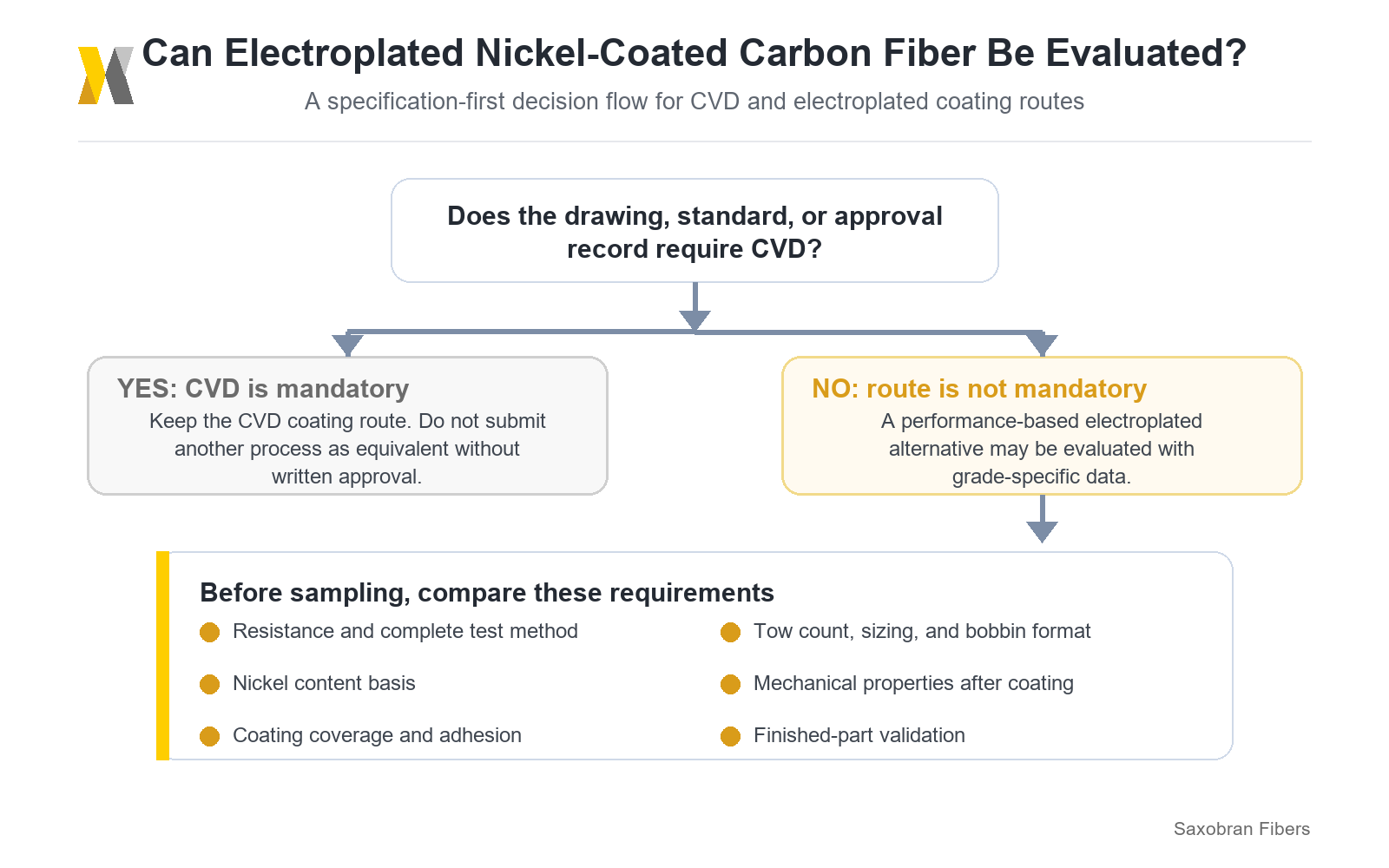
CVD may be necessary when the customer’s design has already been validated with a vapor-deposited coating, or when the specification clearly requires that process.
This includes drawings, customer standards, approved material lists or qualification records that identify CVD as a controlled manufacturing requirement. In these cases, an electroplated material should not be submitted as an equivalent without the customer’s written approval.
When Can Electroplated Nickel Carbon Fiber Be Considered?
An electroplated alternative may be evaluated when the deposition route is not mandatory and the project is controlled by measurable material or finished-part requirements, such as:
- a defined longitudinal resistance range under agreed test conditions
- a specified nickel content and content basis
- continuous tow supplied on a bobbin or spool
- defined coating coverage, thickness or adhesion requirements
- finished-tow tensile and flex-performance requirements
- compatibility with the customer’s resin, extrusion or composite process
- application-level testing for conductive composites or EMI shielding
The practical question is not whether electroplating is universally “better” or “easier.” It is whether the selected grade meets the same documented electrical, mechanical, coating, environmental and processing requirements of the final design.
Application Boundaries
Electroplated nickel-coated carbon fiber may be evaluated for conductive composites and EMI shielding structures. Shielding effectiveness depends on fiber form, fiber content, layup, resin system, part thickness, frequency range and test method; it is not a fixed property of the tow alone.
For grounding, heating or cable designs, first define the intended electrical function. Static dissipation, protective grounding, lightning-current conduction, resistive heating, cable shielding and main current carrying are different requirements. Nickel-coated carbon fiber is not presented as an automatically qualified drop-in replacement for copper or aluminum conductors, bonding straps or lightning-protection systems. The finished assembly must be tested against the applicable electrical and safety requirements.
What Saxobran Supplies
Saxobran supplies electroplated nickel-coated carbon fiber tow and available product forms, including continuous tow supplied on bobbins or spools. Common nickel content is around 50–55 wt% of the finished coated fiber. Other nickel contents, tow counts, sizing systems, bobbin lengths and product forms should be confirmed according to the selected grade and project requirement.
This supply statement describes Saxobran’s electroplated route. It should not be interpreted as a claim that the material is produced by CVD.
What to Confirm Before Sampling
Before comparing a CVD grade with an electroplated alternative, confirm:
- whether CVD is mandatory, preferred or not specified
- the applicable drawing, standard, approved grade or qualification requirement
- base-fiber grade, filament diameter, tow count and sizing
- nickel composition, nickel content and whether it is reported as wt% of the finished coated fiber
- coating thickness, filament-level coverage, uniformity and adhesion requirements
- target resistance, unit, direction and complete test conditions
- whether tensile strength, modulus and elongation refer to the base fiber or the finished coated tow
- required flex, abrasion, thermal-cycle, humidity, corrosion or other environmental tests
- bobbin length or packaging format
- final application and processing route
- finished-part or system-level validation requirements
For help interpreting these material-level requirements, see how to compare nickel-coated carbon fiber properties and TDS data.
Request Technical Support
If you are evaluating CVD nickel-coated carbon fiber but can consider a performance-based electroplated alternative, tell us whether CVD is mandatory and share the required tow count, nickel content basis, resistance and test method, coating requirements, quantity, packaging and final application.
Saxobran can conduct an initial technical review and provide available TDS information, SEM images and sample availability for the selected electroplated nickel-coated carbon fiber grade. SEM images can help show surface morphology, but the deposition route, composition, adhesion and finished-tow performance should be confirmed through the applicable documentation and tests.