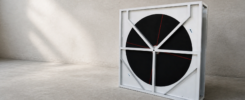
Saxobran supplies wet-laid E-glass fiberglass paper rolls for the flat and corrugated carrier layers used in silica gel, molecular sieve and related zeolite-based desiccant rotors.
The paper is supplied uncoated for subsequent impregnation, corrugation and rotor assembly. Evaluation grades are available at 23, 25 and 30 g/m². The final grade and roll dimensions should be confirmed through coating and corrugation trials under the intended process conditions.
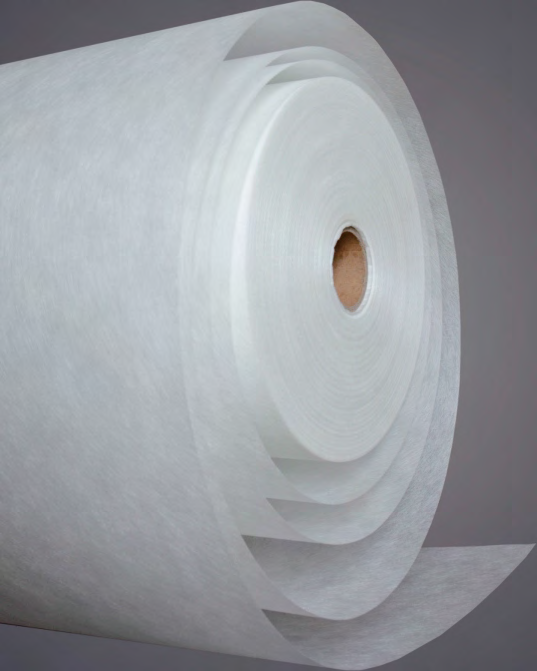
1. Product Overview
In drawings and purchasing documents, this material may also be specified as fiberglass tissue, glass fiber paper or wet-laid glass fiber nonwoven. The binder system is selected for roll handling, liquid impregnation, corrugation and rotor assembly.
· Material: Wet-laid alkali-free E-glass fiber paper
· Supply form: Uncoated rolls for flat and corrugated layers
· Evaluation grades: 23, 25 and 30 g/m²
· Main applications: Silica gel, molecular sieve and related desiccant rotors
· Custom options: Width, roll length, winding direction, packaging and splice policy
2. Key Product Features
· Uniform fiber distribution: Supports consistent liquid uptake and coating distribution across the paper web.
· Converting flexibility: Designed for folding and corrugation under suitable tooling and line settings.
· Dry and wet strength: Supports unwinding, impregnation, drying, corrugation and rotor assembly.
· Porous structure: Suitable for evaluation with silica gel, molecular sieve and related formulations.
· Project-specific supply: Roll dimensions and quality documentation can be agreed before ordering.
3. Typical Technical Specifications
The following values are reference data for grade evaluation. Confirm current test methods, tolerances and required COA items before quotation.
| Property | Unit | 23 g/m² | 25 g/m² | 30 g/m² |
|---|---|---|---|---|
| Basis Weight | g/m² | 23 | 25 | 30 |
| Reference Thickness | mm | 0.20 | 0.22 | 0.28 |
| MD Dry Tensile Strength | N/5 cm | ≥50 | ≥50 | ≥65 |
| MD Wet Tensile Strength | N/5 cm | ≥25 | ≥30 | ≥35 |
Reference values do not replace the current technical data sheet. Test methods and acceptance criteria should be agreed before ordering.
4. Processing and Grade Selection
· Impregnation and coating: Uniform fiber distribution can support even penetration of the desiccant slurry. Actual pickup depends on the intended formulation.
· Corrugation and folding: Flexibility and machine-direction strength support flute forming. Final geometry depends on thickness, tooling, moisture and line settings.
· Drying and regeneration: Dimensional stability should be qualified under the intended temperature, humidity and cycle profile.
· Basis weight selection: The choice between 23, 25 and 30 g/m² depends on flute geometry, coating pickup, wet strength, rotor mass, airflow and pressure-drop targets.
5. Applications
· Silica gel desiccant wheels: Carrier layers for commercial HVAC, industrial dehumidification and humidity-control systems.
· Molecular sieve rotors: For low-dew-point systems, subject to formulation and curing compatibility testing.
· Other zeolite-based rotors: Evaluate against formulation, process temperature, flute geometry and finished-rotor requirements.
6. Custom Rolls and Quality Control
· Roll details: Confirm width, roll length, winding direction, packaging and splice policy.
· Quality documentation: Test methods, sampling frequency and lot-release requirements can be agreed before ordering.
· Storage: Keep rolls dry and retain the original packaging until conversion.
· Qualification support: Samples, current technical data and agreed lot-specific COA items can be discussed.
7. Frequently Asked Questions
Is the fiberglass paper supplied as an uncoated roll?
Yes. It is supplied for subsequent impregnation, corrugation and rotor assembly.
Can it be used with silica gel and molecular sieve coatings?
It is intended as a porous carrier substrate. Final compatibility depends on slurry chemistry, coating pickup, curing and finished-rotor requirements.
Which basis weight should I evaluate first?
The starting grade depends on thickness, flute geometry, wet strength, coating pickup and airflow requirements. A coating and corrugation trial is recommended.
Can the roll dimensions be customized?
Yes. Confirm width, core size, roll diameter, roll length, winding direction, splice policy and packaging before quotation.
Related technical guide: Four Properties to Check When Choosing Fiberglass Paper for a Desiccant Rotor
Discuss Your Desiccant Rotor Substrate Requirements
Send your intended application, target basis weight, width, trial quantity and available process requirements for a material recommendation.